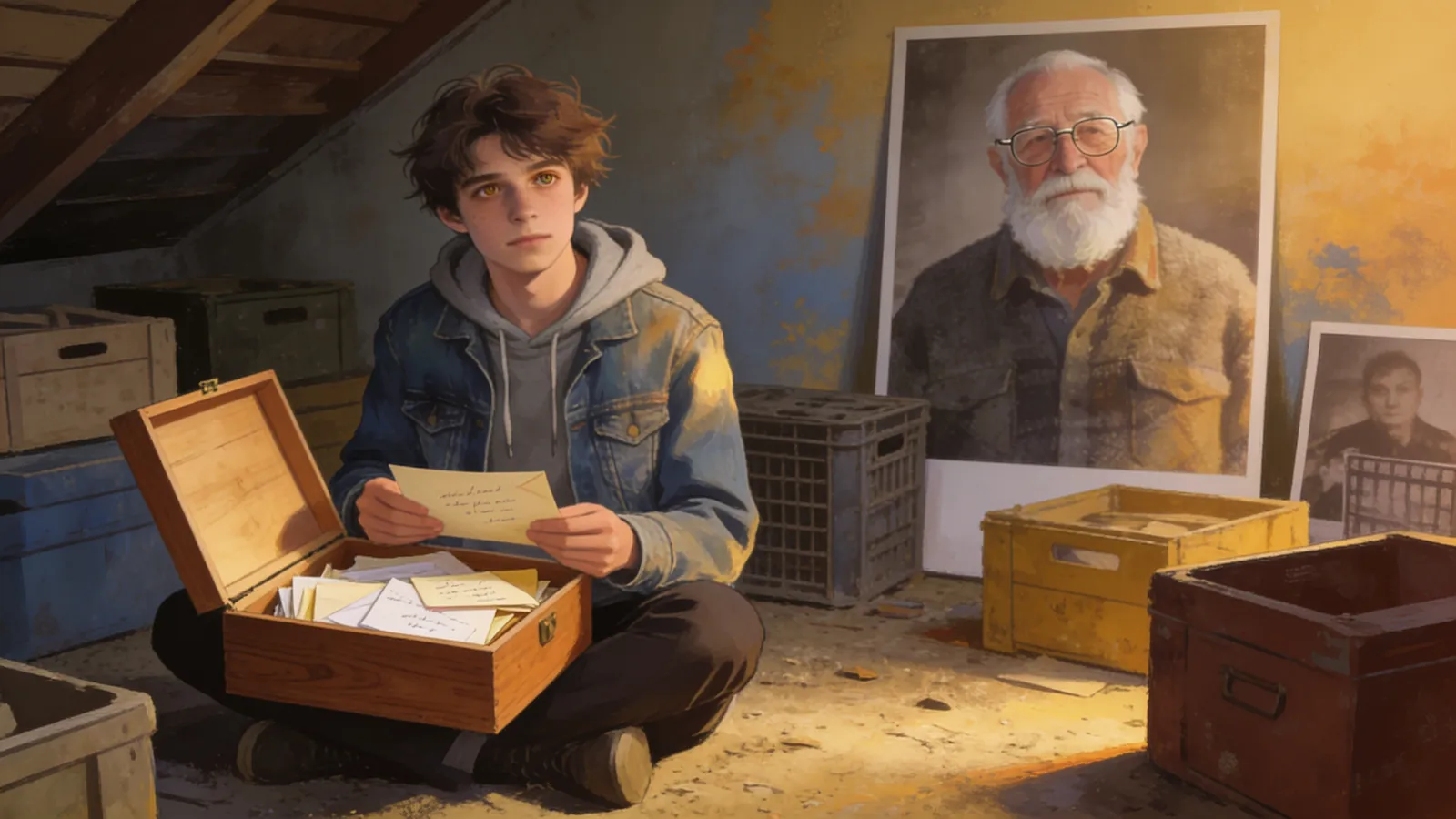
The basement of the Central Post Office smelled of wet wool, ancient adhesive, and the peculiar, metallic tang of silence. Arthur Pendergast liked the silence. It was a reprieve from the screeching brakes and impatient honking of the city streets above. At sixty four, Arthur was a man of soft edges and silver hair, his spine slightly curved from forty years of leaning over sorting tables. He sat at his desk in the Dead Letter Office, a realm of forgotten things, where the air was thick with the ghosts of unsent sentiments. The fluorescent lights overhead hummed a low, mournful B-flat, flickering occasionally as if they too were tired of the long shift.
"Another day, another stack of nowhere," he muttered to himself, his voice raspy from hours of disuse. He pulled a heavy crate toward him, the wood scraping against the linoleum floor. This was his sanctuary. While the rest of the world moved at the speed of light, sending digital pings that vanished into the ether, Arthur dealt in the tangible. He dealt in the ink that had bled into paper and the stamps that had lost their stickiness. He was the final judge of the unaddressed, the unreadable, and the unwanted. Most people called it trash. Arthur called it a responsibility.
He reached into the crate and pulled out a bundle tied with a rotted piece of twine. The paper was yellowed, the edges brittle like dried leaves. As the twine snapped under his touch, a dozen envelopes spilled across his blotter. They were all addressed in the same looping, feminine script, dated February 1974. The stamps featured a red rose, now faded to a dull brick color. Arthur felt a familiar tingle in his fingertips, a spark of curiosity that had never quite died out despite the decades of drudgery. These were not just letters; they were a concentrated dose of history, frozen in time for fifty years.
"Well now, what have we here?" he whispered, adjusting his spectacles. The addresses were all for the same residence: 412 Willow Lane. He knew the area. It was a neighborhood that had once been grand, then fallen into decay, and was now being reclaimed by young professionals with expensive strollers. But in 1974, it would have been a place of manicured lawns and secrets hidden behind heavy velvet curtains. He picked up the first envelope. It was addressed to a Mr. Silas Thorne. The return address was missing, but the scent of the paper, a faint, lingering ghost of lavender, suggested a woman of particular habits. Arthur felt a pang of guilt, a sensation he always experienced before opening a dead letter, even though it was technically his job to find clues for delivery. He slid a silver letter opener through the crease, the sound like a sharp intake of breath in the quiet room.
The letter inside was not the flowery Valentine Arthur expected. There were no poems about roses or sugar. Instead, the words were sharp, written with a nib that had pressed so hard it nearly tore the parchment. 'Silas,' the letter began, 'I cannot keep the lie for another season. The boy deserves to know that his father is not the hero you have painted in your stories. Every time I see him look at you with those trusting eyes, my heart breaks for the truth we are burying.' Arthur felt a cold chill settle in his chest. This was not a message of love, but a confession of a fracture. It was a brutal honesty that had been delayed by a postal error, a misdirection of fate that had kept this secret buried for half a century.
Arthur leaned back in his creaking chair, the springs groaning in protest. He thought of his own wife, Martha, who had passed away five years ago. Their life had been built on a foundation of simple truths and shared morning coffees. He couldn't imagine a life built on a foundation of silence. He looked at the other letters in the bundle. They were all dated within the same week. It was a frantic sequence of correspondence, a woman trying to find her courage, letter by letter, only for the mailbag to be lost in a warehouse fire or a forgotten corner of a sorting facility.
"Fifty years late," Arthur sighed, his eyes tracing the jagged handwriting. "Is the truth still the truth after so much time has passed? Or does it just become a weapon?" He knew he should probably log them into the system as 'undeliverable' and send them to the shredder. That was the protocol. But Arthur had never been much for protocol when it came to the heart. He had spent his evenings over the last year hand-delivering what he could, acting as a silent ghost of Christmas past, or in this case, Valentine's past. He liked to think he was closing circles, tying knots that had been left frayed.

He stood up and walked to the small sink in the corner, splashing cold water on his face. The reflection in the spotted mirror showed a man who looked older than he felt. He had no children of his own, no legacy but these piles of paper. Maybe that was why he cared so much. If he could fix one story, maybe his own quiet life would mean something more. He reached for his coat, a heavy navy wool car coat that smelled of mothballs. He tucked the bundle of 1974 letters into his inner pocket, feeling the weight of them against his ribs. He would go to Willow Lane. He would see if the Thornes were still there, or if the ghosts had moved on.
The walk to Willow Lane took Arthur through the heart of the city, where the neon signs of trendy bistros clashed with the gray stone of the old cathedral. It was a crisp February evening, the air biting at his cheeks. He reached the neighborhood just as the streetlights began to hum to life, casting long, amber pools of light on the sidewalk. Number 412 was a Victorian house that had seen better days, but it possessed a stubborn dignity. The porch was sagging, yet the brass knocker was polished to a high shine. Arthur stood at the gate, his heart hammering against the letters in his pocket.
He climbed the steps, the wood groaning under his weight. He hesitated, his hand hovering over the knocker. What was he doing? He was an interloper, a man bringing a storm into a house that might have finally found peace. But then he remembered the words in the letter: 'The boy deserves to know.' He struck the door three times. The sound seemed to echo through the entire block. For a long moment, there was no answer. He was almost relieved, turning to leave, when he heard the heavy thud of a deadbolt sliding back.
An elderly woman opened the door. Her hair was a cloud of white, and her eyes were sharp, guarded behind thick lenses. She wore a cardigan the color of dried plums. "Yes? Can I help you?" she asked, her voice thin but steady.
"Good evening," Arthur said, tipping his hat. "My name is Arthur Pendergast. I work for the Post Office. I'm terribly sorry to bother you so late, but I came across some lost mail. It appears to be addressed to this house, from many years ago."
The woman’s expression shifted from suspicion to a strange, weary curiosity. "Lost mail? From how long ago?"
"1974," Arthur replied. He pulled the bundle from his pocket. The woman gasped, her hand flying to her throat. She stared at the envelopes as if they were live coals.

"My God," she whispered. "Those are Clara's letters. I recognize the writing anywhere. She was my sister. She passed away in the spring of seventy five." She looked up at Arthur, her eyes suddenly swimming with tears. "Please, come in. My name is Evelyn. I've waited a lifetime for these, though I didn't know it until this very second."
The interior of the house was a museum of the mid-century. Heavy oak furniture, lace doilies, and the scent of lemon wax and old tea. Evelyn led him into a small parlor where a fire crackled in the hearth, providing the only real warmth in the room. She sat in a high-backed velvet chair, her movements stiff with age. Arthur sat opposite her, feeling like a giant in a dollhouse. He handed her the bundle. Her fingers trembled as she touched the paper, her thumb tracing the faded stamps.
"Clara was always the brave one," Evelyn said, her voice drifting back through the decades. "She was the one who spoke up when things were wrong. I was the one who stayed quiet, who kept the peace. Silas, my husband, he was a complicated man. A pillar of the community, they called him. But inside these walls, he was a shadow. He had a son from a previous marriage, Julian. Silas told the boy his mother had run away because she didn't love him. It was a lie to keep the boy dependent on him, to keep him under his thumb."
Arthur watched as she opened the first letter. He felt like he was watching a controlled demolition. As she read, the lines on her face seemed to deepen. "Clara knew," Evelyn whispered. "She found out the truth about Julian's mother. She tried to tell me, but I wouldn't listen. I was too afraid of Silas, too afraid of losing the life I had. I told her to stay out of it. We had a terrible falling out over it. She died a few months later in a car accident, and we never spoke again. I always thought she had just given up on us."
She looked at the letter, her tears finally spilling over. "But she didn't give up. She was writing to him. She was trying to reach him through the mail because I wouldn't let her in the house. And the letters never arrived. Silas died ten years ago, taking his secrets to the grave, and Julian... Julian is a broken man, Mr. Pendergast. He lives in the carriage house out back. He drinks too much and talks too little, believing to this day that he was abandoned by the only woman who ever loved him."
Arthur felt a lump in his throat. The weight of the letters was no longer in his pocket; it was in the air between them. "It's not too late," he said softly. "The truth is here now. It took a long detour, but it arrived."
Evelyn looked at the fire, the flames reflecting in her glasses. "Is it a kindness to break a man's heart all over again? To tell him his father was a monster and his mother was a saint who was kept from him? He’s sixty years old now. How do I tell him his whole life was a fiction?"

Arthur leaned forward, his hands clasped between his knees. "I've spent forty years in the Dead Letter Office, Evelyn. I’ve seen thousands of messages that never made it. Some were bills, some were advertisements, but the ones that matter, the ones people really care about, are always about the truth. I’ve learned that a lie is like a cancer. It doesn't matter how old it is; it still eats away at the soul. Julian might be broken, but maybe he's broken because he's been living in the dark. Light hurts when you first see it, but it's the only way to see the path out."
Evelyn clutched the letters to her chest. "He’s out there now. In the carriage house. He’s probably sitting in the dark, listening to those old jazz records. He never married. He never had children. He said he didn't want to pass on the 'abandonment gene.' My God, what have we done?" She looked at Arthur, her eyes wide with a sudden, frantic energy. "Will you come with me? I don't think I can do this alone. I’ve been a coward for fifty years. I need a witness."
Arthur hesitated. He was a mailman, not a therapist. He was a deliverer of words, not a healer of families. But he looked at the fragile woman before him and realized that his journey hadn't ended at the front door. He was part of this story now. He had carried these letters through the cold night; he might as well carry them the last hundred yards.
"I'll come," he said.
They walked out the back door, into a small courtyard dusted with a light layer of frost. The carriage house was a small, stone building at the edge of the property. A single amber light glowed in the upper window. The sound of a lonely saxophone drifted through the air, a slow, mournful tune that seemed to vibrate in the very stones of the path. Evelyn's breath came in short, ragged puffs of white. She stopped at the door of the carriage house and turned to Arthur.
"If he hates me," she whispered, "I suppose I deserve it."
"He won't hate you for the truth," Arthur said, though he wasn't entirely sure if he believed it. "He'll hate the time that was lost, but he'll have the truth to keep him warm."

Evelyn knocked. It was a soft, hesitant sound, barely audible over the music. After a moment, the music stopped. Footsteps heavy and slow approached the door. It opened to reveal a man with a wild mane of gray hair and a face etched with the deep lines of a life lived in disappointment. He looked from Evelyn to Arthur, his brow furrowed in confusion.
"Evelyn? What's wrong? Is there a fire?" Julian asked, his voice gravelly and deep.
Evelyn didn't speak at first. She simply held out the bundle of letters. Julian looked down at them, his eyes squinting in the dim light of the porch. "What's this? Some more of your old catalogs?"
"No, Julian," Evelyn said, her voice finally finding its strength. "These are letters from your Aunt Clara. They were written in 1974. They were lost in the mail for fifty years. This gentleman, Mr. Pendergast, found them and brought them to us tonight. You need to read them. You need to read them right now."
Julian took the bundle, his large, calloused hands looking clumsy against the delicate paper. He stepped back into the room, inviting them in with a jerk of his head. The carriage house was cluttered with books, records, and half finished woodcarvings. It smelled of cedar and stale tobacco. Julian sat at a small kitchen table and began to read.
Arthur and Evelyn stood by the door, two silent sentinels. The only sound was the ticking of a clock and the rhythmic rustle of paper as Julian moved from one letter to the next. His face was a mask of concentration at first, but as he reached the third letter, his jaw began to tremble. He reached the part where Clara described seeing his mother at the train station, how his mother had been crying, how she had tried to take Julian with her but Silas had threatened to have her arrested for kidnapping.
Julian’s breath began to come in short, sharp gasps. He didn't look up. He just kept reading, his eyes devouring the words as if they were water and he was a man dying of thirst. The final letter was the shortest. It was a direct plea to Julian, written to a ten year old boy who would never see it. 'Julian, my sweet boy, never believe you were not wanted. Your mother loves you more than her own life. She is waiting for you in the city of roses. One day, you will find your way to her.'

Julian let the letter fall to the table. He put his head in his hands and began to sob. It wasn't a quiet cry; it was a deep, guttural sound that seemed to come from his very bones. It was the sound of fifty years of pain being forced out through a narrow opening. Evelyn moved toward him, her arms outstretched, but she stopped, unsure if she would be welcomed.
"She didn't leave me," Julian choked out, his voice muffled by his palms. "She didn't leave me. He lied. He lied about everything."
Evelyn sank into the chair next to him and placed a hand on his shoulder. "I'm so sorry, Julian. I knew she was trying to tell us something, but I was too weak to listen. I let him rule this house with his shadows. I am just as much to blame."
Arthur stood in the corner of the carriage house, feeling like a ghost. He had done his job. The letters had been delivered. But he realized that delivery was only the beginning. The aftermath was where the real work happened. He watched as Julian finally looked up, his eyes red and swollen. The man looked at Arthur, not with anger, but with a bewildered kind of gratitude.
"Why?" Julian asked. "Why did you bring these? You could have just thrown them away. Nobody would have known."
Arthur adjusted his coat. "Because I know what it's like to live with silence, Mr. Thorne. My wife, Martha, she used to say that the truth is the only thing that doesn't change when you turn out the lights. I’ve spent my life surrounded by things that never made it to where they were going. I just couldn't let these be part of that pile anymore."
Julian looked back at the letters. "She said 'the city of roses.' That's Portland. My mother was from Portland. She always talked about the gardens there."

"She might still be there, Julian," Evelyn said softly. "Or her family might be. You have a name now. You have a place. You have a reason to look."
Julian stood up, his height dominating the small room. He looked around his cluttered home as if seeing it for the first time. The woodcarvings, the dusty records, the stagnation of a half century. He picked up the letters and tucked them into his shirt pocket, right over his heart. "I’ve spent my life waiting for a permission slip to be happy," he said. "I think this is it."
He turned to Evelyn. There was a moment of tension, a flicker of the old resentment, but then he reached out and pulled her into a clumsy, powerful hug. She buried her face in his chest, her small frame shaking. Arthur felt a tear prick at his own eye. He turned toward the door, wanting to give them their moment.
"Wait," Julian called out. Arthur stopped and turned. "Thank you, Mr. Pendergast. Most people just bring the mail. You brought my life back."
Arthur nodded, a small, humble smile touching his lips. "It was an express delivery, Julian. Just a bit delayed."
He stepped out into the night. The air felt warmer now, or perhaps it was just the glow of the task completed. He began the long walk back to his apartment, but he didn't feel tired. He felt light. He felt like he was finally retiring, not from a job, but from the burden of being a bystander.
The next morning, Arthur arrived at the Post Office before the sun was fully up. The building was cold, the heat not yet having kicked in, but he didn't mind. He went down to the basement, to his desk in the Dead Letter Office. But today, the room didn't feel like a tomb. It felt like a library of possibilities. He looked at the crates of unsorted mail with new eyes. How many other lives were waiting to be reclaimed? How many other truths were buried under layers of dust?

His supervisor, a blunt man named Miller who cared only about quotas and efficiency, walked in around eight o'clock. Miller frowned at Arthur, who was already deep into a new stack of letters.
"Pendergast, you're early. And you're smiling. It's unsettling," Miller said, leaning against the doorframe. "You know the retirement party is on Friday. You should be slacking off, not digging through that junk."
Arthur didn't look up from a postcard dated 1982. "It's not junk, Miller. It's a backlog of human connection. And I’m not retiring just yet. I have a few more deliveries to make."
Miller snorted. "You’re taking this 'dead letter' thing too literally. They're dead for a reason. People move on. They forget. They die. You're chasing ghosts."
"The ghosts are the ones who don't get the letters," Arthur replied calmly. "The ones who get them... they become something else. They become whole."
Miller shook his head and walked away, muttering about old men and their eccentricities. Arthur didn't care. He found a letter from a soldier in Vietnam to his daughter, a letter that had never reached its destination because of a smeared zip code. He found a Valentine from a shy teenager in 1995 who never got to tell his crush how he felt. He took a notebook and began to make a list. He had three days until his official retirement. Three days to make as many connections as he could.
He spent the day researching addresses, cross-referencing names with online databases, and using his old-school knowledge of the city's changing street names. By the time the clock struck five, he had a dozen letters ready for personal delivery. He felt like a detective of the heart, a man on a mission that was far more important than any pension or gold watch.

The following evening, Arthur found himself in a part of the city he rarely visited, a neighborhood of sleek glass towers and high-end boutiques. He was looking for the daughter of the Vietnam soldier. Her name was Sarah, and according to his research, she was now a prominent lawyer with an office overlooking the harbor.
He entered the lobby, feeling out of place in his worn coat and sensible shoes. The receptionist was young and polished, her hair a perfect blonde bob. "Can I help you, sir? Do you have an appointment?"
"I'm here to see Sarah Jenkins," Arthur said. "I have something for her. It's... it's a matter of some historical importance."
The receptionist looked skeptical, but something in Arthur's steady gaze made her pause. She made a quick phone call, and a few minutes later, a woman in her fifties, dressed in a sharp charcoal suit, stepped into the lobby. She looked busy, her eyes darting to her watch.
"I'm Sarah Jenkins. How can I help you?" she asked, her tone professional but not unkind.
Arthur reached into his bag and pulled out the 1968 envelope. It was stained with what looked like red clay from a distant jungle. "My name is Arthur Pendergast. I'm with the Post Office. I found this in the Dead Letter Office. It's from your father, written from Da Nang."
Sarah's face went perfectly still. The professional mask didn't just slip; it shattered. She reached out, her hand hovering over the envelope as if she were afraid it would vanish if she touched it. "My father... he died in sixty eight. We never got any letters from his final month. My mother always thought he hadn't had time to write."

"He had time," Arthur said softly. "The address was blurred by the rain, I think. It’s been waiting for you for fifty six years."
Sarah took the letter. She didn't open it there in the lobby. She held it against her forehead, her eyes closing tight. A sob escaped her, a small, sharp sound that made the receptionist look away in embarrassment. But Arthur just stood there, a witness to the healing.
"Thank you," Sarah whispered, her voice thick with emotion. "You have no idea... my mother is still alive. She’s ninety. I’m going to take this to her right now. This is the last thing we have of him."
As Arthur walked back to the subway, he felt a warmth that had nothing to do with the weather. He was a man with no children, but tonight, he felt like he had a thousand families. He was the thread that was sewing the past back to the present.
On the day of his retirement, the basement of the Post Office was unusually crowded. Word had gotten out about Arthur’s 'special deliveries.' Even Miller seemed a bit subdued, standing by a table with a cheap supermarket cake and some lukewarm punch.
"Well, Pendergast," Miller said, clearing his throat. "You’ve been here a long time. You’re a weird guy, but you’re a good worker. Here’s your watch. Don't spend it all in one place."
The small group of clerks clapped politely. Arthur took the watch, a simple gold-plated thing, and thanked them. But his eyes kept drifting to the door. He was waiting for something, though he wasn't sure what.

Just as he was about to pack his small box of personal belongings, the door at the top of the stairs creaked open. A man stepped in, followed by an elderly woman. It was Julian and Evelyn. Julian looked different. He was clean-shaven, his hair trimmed, and he wore a bright red tie that clashed spectacularly with his tweed jacket. He was carrying a large bouquet of roses.
"Arthur!" Julian called out, his voice booming in the quiet basement. "We almost missed you!"
Evelyn hurried forward and hugged Arthur, her eyes bright. "We wanted to tell you. Julian found her! Well, he found her family. His mother passed away five years ago, but he has two half-sisters in Portland. He’s leaving tomorrow to meet them. They didn't even know he existed!"
Julian handed the roses to Arthur. "I wanted to bring these to you. In the 'city of roses,' they say these mean a new beginning. You gave that to me, Arthur. You gave that to all of us."
Arthur looked at the roses, their scent filling the dusty room, overpowering the smell of old paper and wet wool. He felt a profound sense of peace. He looked at his desk, now clean and empty, and then at the faces of the people he had helped.
"I think," Arthur said, his voice steady and clear, "that this is the best Valentine's Day I've ever had."
He walked out of the Post Office for the last time, not as a man who was finished, but as a man who was just beginning. He had a list of addresses in his pocket, a bag full of old letters, and a heart that was no longer dead. The Dead Letter Office was closed for him, but the world was wide open, and there were still so many stories waiting to be delivered.